
Two months after Fable 5.1, there is another version. At 19:04 UTC on 9 November, Anthropic’s developer account on X posted a single sentence with three numbers in it: Fable 5.2 is up to 30 percent faster than 5.1 and costs $8 and $40 per million tokens, down from $10 and $50. Thirty seconds later came a post with a table of fourteen benchmarks.
I put that table next to the announcement page and the pricing page in the docs. They mostly agree. Where they differ, it is about what you get for your money.
What was announced
As with the previous two releases, this is one model under two names. Fable 5.2 has strict cybersecurity and biology safeguards and is open to everyone. Mythos 5.2 is the same model with looser safeguards, and you only get it through a verification programme.
| What | Fable 5.2 | Compared with 5.1 |
|---|---|---|
| Model ID | claude-fable-5-2 |
new |
| Input / output price | $8 and $40 per million tokens | was $10 and $50 |
| Cache reads | $0.20 per million tokens | was $0.25 (same 0.025 multiplier) |
| Speed | up to 30% faster | Anthropic’s claim |
| Fast mode | up to 2.5x faster generation, $16 and $80 | double the price |
| Available on | Claude Platform, Claude Code, AWS, Google Cloud, Azure | from today |
| Mythos 5.2 | via the Cyber and Life Sciences Verification Programs | same access route |
Subscribers get extra room this week. Anthropic says plans that include Fable get one to three resets of their Fable limit, depending on how long they have subscribed, and that Fable can use up to 50 percent of the weekly limit on Pro and standard Team seats.
The table
This is the table Anthropic published with the announcement, in the version Ado (adocomplete) shared on X. The highlighted cell is the top score in each row.
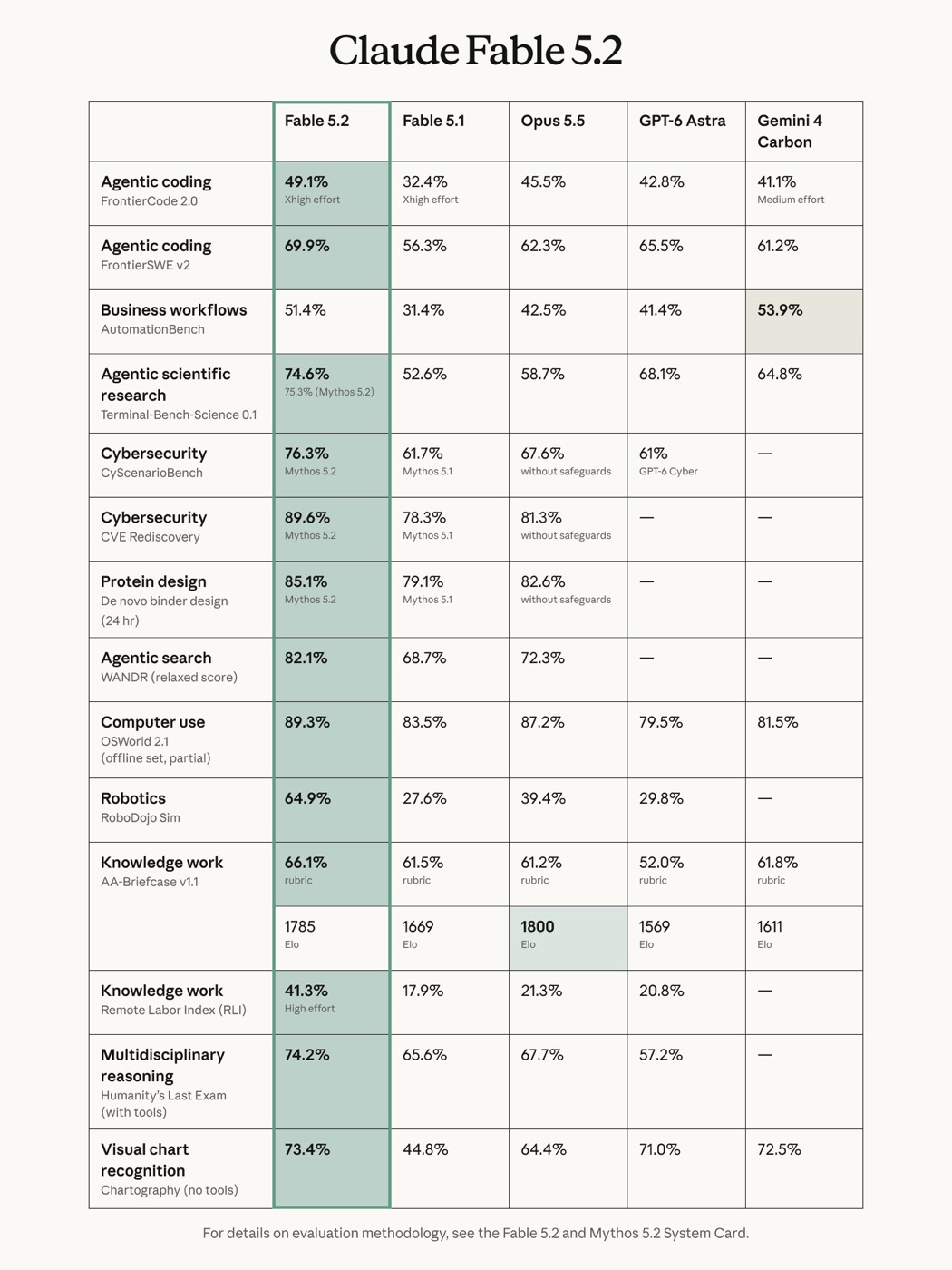
The big jumps are on long, unsupervised work. On the Remote Labor Index, which uses real tasks of the kind a freelancer would be hired for, the score goes from 17.9 to 41.3 percent. Simulated robotics goes from 27.6 to 64.9 percent. That fits the examples in the announcement, where an engineer had Fable 5.2 build an operating system from an empty folder, with more than 1,000 subagents working for eight days straight.
Two rows go to someone else. On AutomationBench, which measures business workflows, Gemini 4 Carbon scores 53.9 percent against 51.4 for Fable 5.2. On AA-Briefcase, a knowledge-work test, Fable 5.2 leads on the rubric score, but Opus 5.5 wins on Elo, 1800 to 1785. Opus 5.5 costs half as much.
Some cells are empty. Seven rows have a dash for GPT-6 Astra or Gemini 4 Carbon. And in the cybersecurity and biology rows, the number in the Fable column belongs to Mythos 5.2, the model without the safeguards that ordinary users get. Next to it, Opus 5.5 is listed “without safeguards”.
What it costs next to Opus
Even after the cut, Fable is the expensive model. According to the pricing page, Opus 5.5 costs $4 and $20 per million tokens, exactly half. Cache reads come out level: Fable charges 0.025 times the input price, Opus 5.5 charges 0.05 times, and both land on $0.20 per million tokens.
Anthropic makes that comparison itself on one benchmark. On FrontierCode 2.0, which checks whether open-source maintainers would merge a model’s code changes, Fable 5.2 at High effort scores about the same as the best Opus 5.5 result (45.3 against 45.5 percent), Anthropic writes, “for roughly half the cost per task”. Only at the top setting, Xhigh, does Fable reach 49.1 percent.
If you use Claude through a subscription, the token price changes nothing. What counts there is how fast you burn through your weekly limit, and the extra resets are temporary.
The caveat
- The vendor holds the ruler. All fourteen rows come from Anthropic’s own measurements. The Fermat chart in the announcement, where Fable 5.2 and Opus 5.5 spend thirty hours with about 1,000 agents formalising a proof, is “a single run per model” according to its caption. Outside evaluators such as the UK AI Security Institute and METR tested the model for safety before release, not for these scores.
- The best number is not your model’s. The cybersecurity scores in the Fable column belong to Mythos 5.2. In a footnote, Anthropic writes that on its own evaluations the model finds vulnerabilities “roughly on par with Opus 5.5”, and that the high counts come from one tester’s audit.
- A thousand agents also produce a thousand times the work to check. The operating system in the announcement shows how much you can hand off. Anyone who copies that has to verify the result, and the responsibility for what goes wrong stays with whoever gave the instruction. On top of that, Anthropic now watches for patterns across many requests rather than single responses with these models. Companies that don’t want that can run the monitoring inside their own infrastructure, but that option is still in private beta.
What I’m doing with it
At the time of writing I have not used Fable 5.2 myself. With Fable 5, I ran it through real work (in Dutch) before making any claims, and I want to do the same here. Until then my question per task stays the same: is this work where Fable is measurably better, or is Opus 5.5 good enough at half the price?
Frequently asked questions
How much does Claude Fable 5.2 cost?
On the API, $8 per million input tokens and $40 per million output tokens. Cache reads cost $0.20 per million tokens. Fast mode, which generates up to 2.5 times faster, doubles that to $16 and $80.
What is the difference between Fable 5.2 and Mythos 5.2?
They are the same model. Fable 5.2 has strict cybersecurity and biology safeguards and is available to everyone. Mythos 5.2 has looser safeguards and is only available through the Cyber Verification Program or the Life Sciences Verification Program.
Is Fable 5.2 better than Opus 5.5?
On every benchmark in Anthropic’s table, Fable 5.2 scores higher than Opus 5.5, with one exception: the Elo score for knowledge work, which Opus 5.5 wins narrowly. Opus 5.5 costs half as much. Whether the gap is worth the money depends on how long and how unsupervised the task is.
Sources
- Anthropic, Claude Fable 5.2 and Claude Mythos 5.2, announcement, 9 November 2026 — anthropic.com
- @ClaudeDevs on X, 9 November 2026 — x.com
- @adocomplete on X, benchmark table, 9 November 2026 — x.com
- Claude Platform docs, Pricing, accessed 9 November 2026 — platform.claude.com
- CNBC, Anthropic releases Claude Fable 5.2 and Claude Mythos 5.2, 9 November 2026 — cnbc.com
Checked on 9 November 2026, within an hour of the announcement. Prices and availability come from the announcement and the pricing page, and the two agree. I could not verify the benchmarks myself; they come from Anthropic’s table, and I have not yet read the system card with the methodology. I have not watched the video that came with the announcement.